


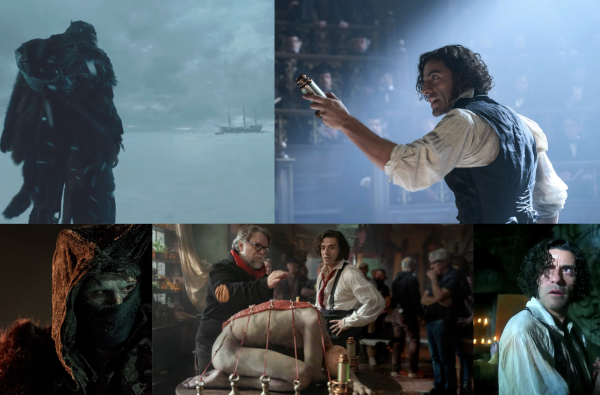
Writer and director Mr. Guillermo del Toro’s movie adaptation of Ms. Mary Shelley’s novel Frankenstein is attracting attention for its resonant themes and star-studded cast. The movie hit select theaters October 17 and debuted on Netflix November 7, according to forbes.com. Mr. del Toro took creative liberties adapting a story he had long admired, according to time.com.
The movie follows the story of Victor Frankenstein, a brilliant but obsessive scientist, and the Creature he brings to life. Victor gets caught up in his own selfish goal of breaking scientific boundaries by creating this monster, leading him overlook the possible repercussions. The movie begins with a crew trapped in the Arctic rescuing Victor, who expresses his fear about his own creation. Mistreated and abandoned by his creator, the Creature lives a separate life from Victor until the film’s finale, when the two reconcile. Ultimately, the Creature saved the ship, revealing his empathetic character, according to decider.com.
At Sacred Heart Greenwich, students in the English Literature Honors class read Ms. Shelley’s novel in tenth grade. Dr. David Smigen-Rothkopf, Upper School English Teacher, discussed the novel’s importance in the curriculum.
“There’s a traditional emphasis on Frankenstein because it helps us engage with fundamental questions about what it means to be human,” Dr. Smigen-Rothkopf said. “And I think that Frankenstein‘s ability to help students in particular engage with those core fundamental questions is why we have it built into the curriculum here at Sacred Heart.”
Mr. del Toro’s adaptation incorporates a few key changes from Ms. Shelley’s classic novel. In the film, the Creature, played by Mr. Jacob Elordi, demonstrates greater empathy than in the novel, when murders innocent people after grappling with Victor’s abandonment of him. Mr. del Toro emphasizes Victor’s faults, portraying him as directly responsible for the deaths of people around him. The movie also reimagines the story’s ending with a more positive resolution, allowing Victor and the Creature to forgive each other and establish a father-son-like relationship. The movie’s ending, inspired by Mr. del Toro’s own struggle to break familial behavioral cycles, shows the potential to move past family struggles, a theme that resonates with audiences, according to time.com.
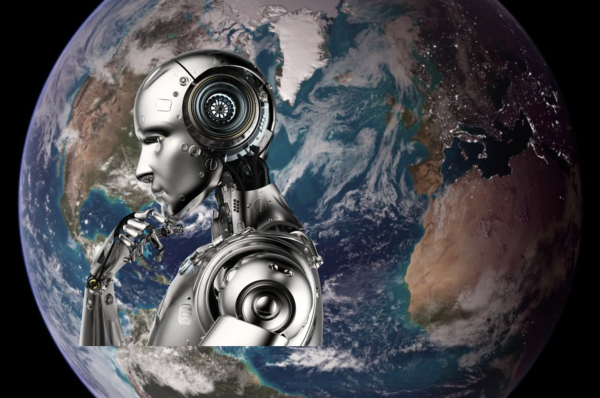
Frankenstein is particularly relevant today because of its connection to modern technologies, such as artificial intelligence (AI). AI is rapidly growing in the United States (US) and is on track to continue expanding. In fact, 1.7 to 1.8 billion people have used AI, and 500 to 600 million of those use AI software daily, according to menlovc.com. Mr. del Toro has expressed concerns about AI and worries that society is reflecting Victor Frankenstein’s same lack of consideration for the consequences of new technologies, according to npr.org. Though Mr. del Toro preserved the novel’s central themes, movie adaptations can be controversial. Dr. Smigen-Rothkopf shared his thoughts on the movie’s alterations.
“A movie and a film are both doing different things, and a director is going to have a different message that they want to convey and a different set of tools to do so from an author,” Dr. Smigen-Rothkopf said. “When it comes to adaptation, I think it’s a good thing. It’s actually something that we’ve been doing for a long time as a human species: taking old stories, telling them in new ways, introducing new audiences to them.”
Mr. del Toro’s appreciation and love for Frankenstein are crucial to creating an adaptation that maintains the story’s traditional themes while also adding his own unique twist. Mr. del Toro commented on his appreciation for the novel.
“I’ve lived with Mary Shelley’s creation all my life,” Mr. del Toro said, according to time.com. “For me, it’s the Bible. But I wanted to make it my own, to sing it back in a different key with a different emotion.”
Featured Image by Liv Hegarty ’27