



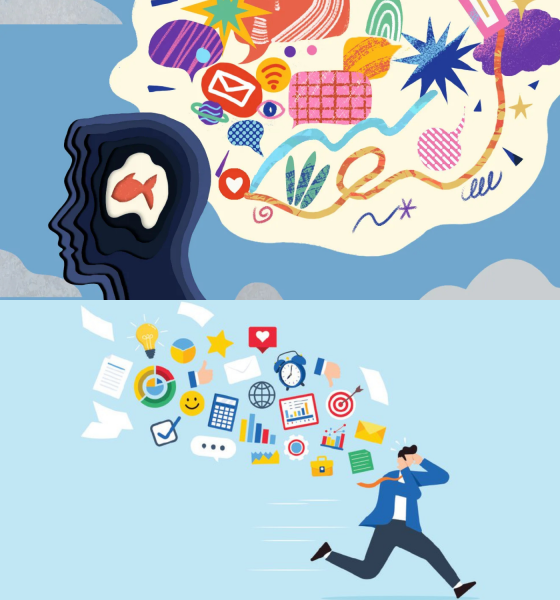
In the modern age of social media and technology, digital content creators strive to make their content short and succinct to capture their audience’s attention and get the most views possible. As a result of this marketing phenomenon, viewers’ attention spans are getting increasingly shorter, according to asa.org. Shortened attention spans can cause people, especially teenagers, to have trouble concentrating on simple tasks, such as schoolwork or even just reading an email, without becoming distracted, according to The New York Times.
TikTok, a social media platform centered around short-form videos, has about two billion users who log onto the platform for an average of 95 minutes per day, according to richmond.edu. In fact, the optimal length of TikTok videos to maximize user engagement is between 21 and 34 seconds. This allows the average TikTok user to consume over 200 videos a day, yet, often forgetting much of the content consumed. The app recruits this high level of engagement from its users through creating short, reward-based videos that increase users’ dopamine levels and thus make the app addicting, according to brown.edu. Moreover, emerging research suggests that children who watch these short, addictive videos have increased difficulty engaging in activities that do not offer constant, instant gratification and dopamine spikes, according to richmond.edu.
The average attention span for people looking at a screen dropped from two and a half minutes in 2004 to just 47 seconds in 2021, according to apa.org. Dr. Gloria Mark, a professor of informatics at the University of California, Irvine, shared the results of an experiment she and her team performed on how the internet negatively affects people’s ability to focus and makes multitasking stressful and unproductive, according to apa.org.
“We find in our research a correlation between frequency of attention switching and stress,” Dr. Mark said, according to apa.org. “We show that stress goes up. We know from decades of research in the laboratory that when people multitask, they experience stress and blood pressure rises. And in our studies, we’ve also simply asked people with well valid instruments to report their stress […], and it’s reported to be higher the faster that we measure [their] attention shifting. So every time you switch your attention, you have to reorient to that new activity, that new thing you’re paying attention to, and it takes a little bit of time.”
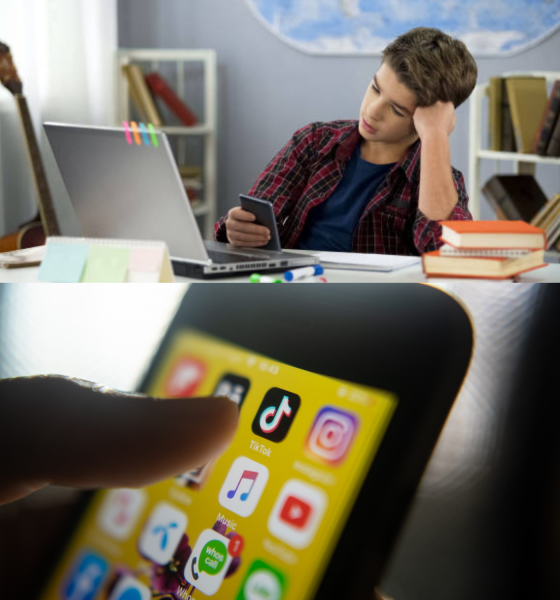
However, healthy habits, especially when integrated into daily life at a young age, can help to rebuild attention spans damaged by social media. These habits include exercising, finding entertainment outside and off of screens, setting time limits on electronic devices, and ensuring restful sleep, according to wsj.com. Mrs. Jillian Bozzi, Upper School History Teacher, explained the importance of teenagers building healthier habits for their attention spans.
“The decreasing attention span is really, I think, a combination of social media and the residual effect of COVID-19,” Mrs. Bozzi said. “I think these two things were kind of the perfect storm to hit the attention span issue, and it doesn’t seem to be going away any time soon. I think that educating teens on how their brains work, such as to why they get dopamine releases and feel excited when on social media, is essential for them to build healthier habits for themselves. If teens are always active on social media, whether that involves checking how many likes they’ve gotten on their post or if their favorite person they follow posted a new video that day, their brains become accustomed to frequent stimulation and have trouble focusing when not in front of a screen.”
Featured Image by Blaire Williamson ’27
