

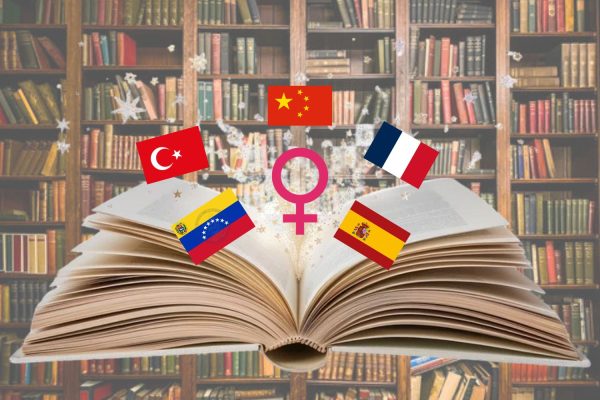
This August marks the 13th year of celebrating Women in Translation Month. This month works to address the gender imbalance in translated literature, as English translations often underrepresent women writers, according to womenintranslation.org. It allows for the exploration of the significance that these women’s work brings to a global audience. Without access to these works, English readers lose valuable perspectives from women authors across different cultures, according to press.princeton.edu. Women in Translation challenges longstanding beliefs and biases that have led to the under-appreciation of women writers in translated literature, according to press.princton.edu.

Ms. Meytal Radzinski, a blogger and academic, founded Women in Translation Month in 2014. She examined the publishing field and recognized that men predominantly translated literature, according to cup.columbia.edu. Historically, translation has served as a way for women to contribute to the field because society considered translation lesser than other intellectual fields between 1600 and 1720, according to birmingham.ac.uk. Many women during this time took advantage of this fact and produced translated works, mostly anonymously. By only reading translated works by men, readers miss out on women’s perspectives in both writing and technique, according to pen.org. This gap continues to influence the literary field, as publishers still underrepresent women translators.
Although the progress has been gradual, translated literature by women has steadily increased over time. The amount of fiction works translated by women has risen consistently since 2008, climbing from 24 percent in 2008 to 47 percent between 2022 and 2024, according to publisherweekly.com. While the change may seem small at first, the increase reflects the impacts of programs like the Women in Translation project and the launch of the Translation Database in 2008, which have helped bring greater notice to these works.
Translated works are important vehicles to connect cultures by offering a variety of literature, according to thecrimson.com. Audiences can access and engage with perspectives that would otherwise remain inaccessible. Translated books serve as a tool for cultural exchange and help maintain literary diversity, according to unesco.org. Despite this, English-speaking countries publish only a very small percentage of titles in this genre each year, according to rochester.edu. By expanding the accessibility of translated works, readers can engage in learning perspectives and join a broader community.
There are many women who have broken barriers in the field of translation, but Ms. Edith Grossman, Ms. Ann Goldstein, and Mrs. Emily Wilson have played a major role in these translated works. Ms. Grossman introduced important works of Latin American literature to English-speaking readers, especially through her translations of Mr. Gabriel García Marquez and Mr. Miguel de Cervantes, according to pen.org. Ms. Goldstein gained fame for translating Ms. Elena Ferrante’s Neapolitan novels, allowing a larger audience to enjoy this literature, according to bookclubs.com. Likewise, translator Mrs. Wilson gained recognition for her work on The Odyssey, becoming the first woman to publish a translation of the epic, according to newyorker.com.
There are many efforts to bring recognition to women who work to translate literature. The Warwick Prize for Women in Translation works to eliminate the gender imbalance in translated literature and increase the number of international women’s voices, according to warwick.ac.uk. Awards like these introduce books to a larger audience. Organizations such as PEN American increase activism for the contracts of women translators and provide grants so that they can complete their work, according to englishpen.org. These organizations are especially important to help women translators enter the publishing field. Translated literature provides different perspectives into cultures, and including women authors allows for another diverse voice. Dr. David Smigen-Rothkopf, Upper School English Teacher, discussed the importance of translation and what it can bring to the reader.
“I think the obvious one is probably access,” Dr. Smigen-Rothkopf said. “There is so much, especially in world literature, that we just would not have access to. We can miss out on some of the meaning when we take something like [T]he Odyssey and put it into English. All languages allow different sorts of mental associations and connections that other languages can’t make. So, there’s actually a very strong relationship between the language itself and what’s being conveyed. Translation is therefore an opportunity, not just to restrict, but also to expand what the text can mean, not just in terms of finding a new audience, but in terms of, well, maybe we can learn something new from this.”
Featured Image by Gianna Rodrigues ’27
