


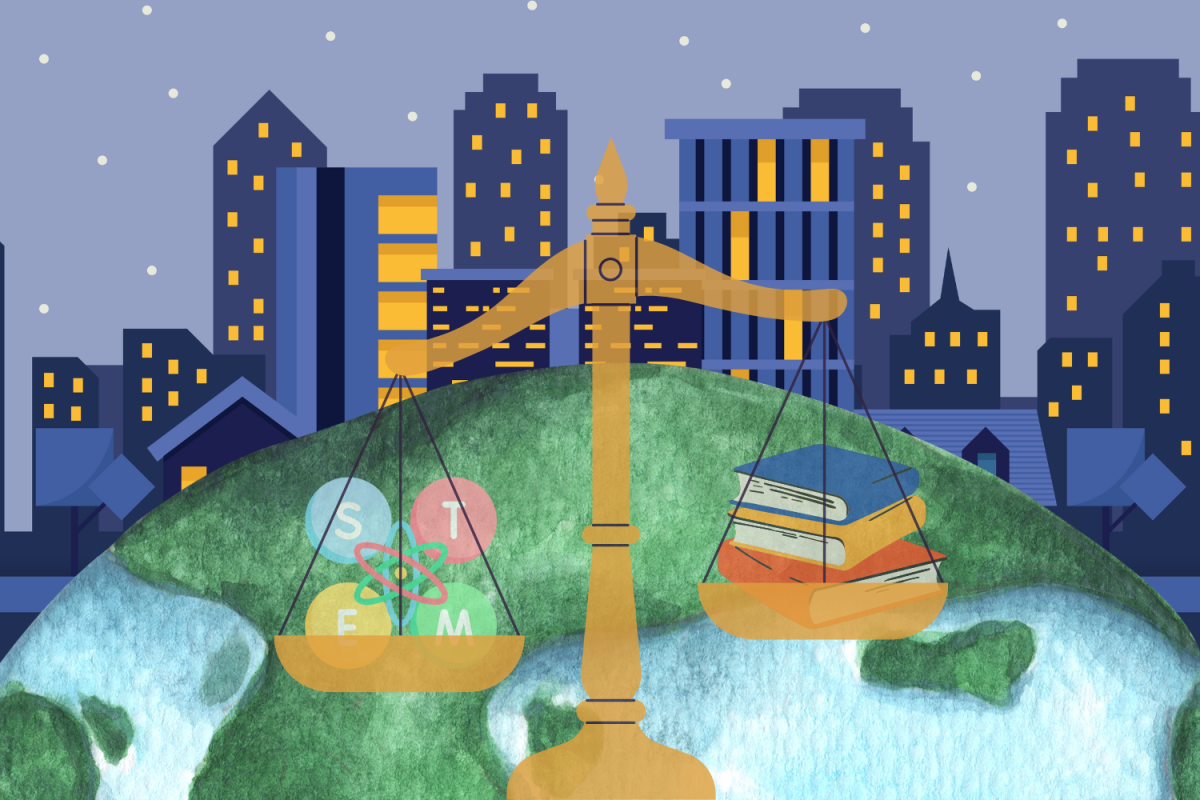
World Philosophy Day arrives each year as a reminder that even in an age defined by speed, progress, and innovation, reflection still plays an essential role in how society moves forward. As technology advances at a pace faster than most can fully understand, philosophy encourages people to slow down, rethink their assumptions, and question the meaning behind that societal progress. While the science, technology, engineering, and mathematics (STEM) fields build the engines of modern life, philosophy asks people to examine why they build these systems at all, according to iep.edu. It challenges society to consider the implications of people’s choices, not just the efficiency of people’s solutions. World Philosophy Day highlights the human desire to search for purpose rather than simply accepting outcomes. It helps people to realize that innovation, no matter how groundbreaking, is incomplete without understanding its impact on individuals and communities. In a STEM-dominated society, this day stands as a call to recognize that wisdom and knowledge must grow side by side, or else progress risks losing its direction.
STEM fields often dominate the conversation about the future, shaping how schools prioritize curriculum, how companies design jobs, and how society defines success, according to nsf.gov. Yet, the humanities provide the intellectual grounding that gives scientific discovery its ethical and social meaning. Philosophy helps people to articulate why discoveries matter beyond their technical function, according to iep.edu. Literature and history reveal how ideas have shaped societies in the past and how those societies thrived, or struggled, when people ignored core values.
These subjects remind society to not reduce the human experience to mere data points, according to medium.com. Without the humanities, scientific and technological progress risks becoming detached from the people it should be helping. The humanities offer perspective, context, and moral clarity, three qualities that science alone cannot supply. They teach people to ask deeper questions about responsibility, fairness, and long-term consequences. Studying the humanities also encourages people to think critically about what progress truly looks like and who benefits from it. When STEM grows without the humanities, our capabilities broaden, but our understanding narrows, creating innovation without insight.
Today’s most complex global challenges demonstrate how inseparable STEM and the humanities truly are. Artificial intelligence (AI) has revealed biases that math alone cannot solve but require ethical reasoning to address harmful patterns, according to nih.gov. Data privacy issues show that technological capability must maintain a balance between moral responsibility and respect for personal autonomy. Genetic engineering pushes society to confront questions about identity, equity, and the limits of human intervention, topics that reach far beyond laboratory walls, according to medium.com. Humanities scholars translate these dilemmas in ways the public can understand, making complex concepts human and relatable. Their work ensures that innovation does not move faster than society can thoughtfully respond to it. Without philosophical guidance, scientific progress can easily outpace our emotional, legal, and cultural readiness. Ethics committees, public policy frameworks, and human-centered design principles all draw heavily from humanities thinking, according to nih.gov. When STEM and philosophy work together, society develops systems that respect human dignity while embracing technological growth. This collaboration creates innovation that is not only advanced but also responsible, inclusive, and sustainable.
People still dismiss the humanities as impractical or less valuable than science and technology, despite their importance, according to jhunewsletter.com. Many people tell students to pursue STEM for financial security, overlooking the fact that humanities skills are foundational across nearly every industry. Humanities students learn to communicate clearly, think critically, and evaluate complex, ambiguous situations, all of which are abilities that employers consistently rank as essential, according to utpb.edu. These skills prepare students for leadership, innovation, and effective collaboration. Creativity, empathy, and communication are valuable survival skills for the modern workplace.
Many successful Chief Executive Officers (CEOs), policymakers, editors, founders, and tech leaders credit their humanities background for helping them understand people and solve problems creatively. Even STEM industries increasingly recognize the need for workers who can interpret human behavior, question assumptions, and contextualize data, according to aacsb.edu. Humanities students excel in these areas because they have become accustomed to analyzing human experience rather than just numerical outputs. Their education prepares them to balance logic with judgment, ambition with morality, and innovation with empathy. When institutions undervalue the humanities, they limit students’ capacity to engage with the world beyond formulas and measurements.
Mr. David Jan Skorton is an American physician and academic who led the Smithsonian Institution from July 2015 to June 2019. He reflected on the need for integration of study between the humanities and the sciences, according to nih.gov.
“Each in its own way, the sciences, arts, and humanities all heighten our collective understanding of ourselves and the world we live in,” Mr. Skorton said, according to nih.gov. “Therefore, when we fully separate the disciplines—when we isolate complementary fields of knowledge—we limit their ability to advance human progress.”
World Philosophy Day invites people to question what it means to live thoughtfully and intentionally in a rapidly evolving society. It challenges the assumption that measurable progress such as productivity, efficiency, and speed holds more value than reflective progress that includes understanding, questioning, and empathy. Philosophy encourages individuals to examine the motivations behind their decisions instead of accepting them as inevitable. It prompts careful consideration of difficult questions about justice, responsibility, and human purpose, even when answers remain uncertain, according to iep.edu.
The humanities create opportunities for deeper dialogue among people with different experiences, allowing space for empathy and nuance. They encourage reflection on the social, cultural, and emotional effects of technological change. As STEM continues to reshape daily life through automation, artificial intelligence, biotechnology, and digital transformation, philosophy helps ensure that human well-being remains at the center of these developments. Reflection becomes a grounding force that prevents society from valuing speed more than substance, according to psychologytoday.com. World Philosophy Day serves as a reminder that knowledge must be alongside wisdom in order to be meaningful. Honoring the humanities means honoring the part of humanity that seeks not only what is possible but also what is right.
The humanities give essential depth and direction to a world increasingly shaped by STEM. Moreover, the humanities remind those who study them that progress is not defined only by efficiency or innovation, but by the values and intentions guiding that innovation. World Philosophy Day highlights the importance of thinking critically about the choices that shape the future. When people center humanity alongside technology, a society can emerge that is not only advanced and creative, but also thoughtful, ethical, and compassionate.
Featured Image by Catherine Ononye ’27
