

Artificial Intelligence (AI) has become more refined and mainstream within society over the past few years. Consequently, it has heavily impacted the entertainment industry and the production of visual media. AI use within entertainment fields can lead to more efficiency, allowing creators to focus more heavily on their art rather than spending excessive time on logistics. Additionally, AI can aid the creativity of entertainment media as well, according to forbes.com. While the use of AI within the media has many benefits, the threats of AI are still prevalent within today’s society, according to raindance.org.
With the average United States (US) adult consuming visual media for seven hours each day, the film industry and other media platforms face increasing pressure to produce video content. Most adults in the US now spend more time watching media on social media platforms than watching television (TV) and film. TV and film accounted for 61 percent of video viewership in 2019, yet this decreased to 50 percent by 2025. However, the emergence of generative AI in entertainment, specifically within filmmaking, has the potential to revive TV and film viewership using new technologies. This could greatly improve the film industry by reducing work time, lowering costs of production, and creating innovative content, according to mckinsey.com.
Generative AI has seen the most success in pre and post-production. In these stages, generative AI can enhance creativity instead of replacing it. In pre-production, AI helps to reduce costs and time through tools such as storyboards, three dimensional set modeling, and camera path planning. In post-production, generative AI assists with cosmetic enhancements and dialogue substitution, according to mckinsey.com.
For example, Flawless AI’s TrueSync tool allows filmmakers to dub content by replacing original dialogue with another language while simultaneously adjusting facial expressions and mouth movements, according to forbes.com. The film The Brutalist used technology like this, specifically Respeecher, to improve the Hungarian dialogue of the actors. Additionally, the film Civil War used generative AI to create promotional posters displaying disastrous events to establish the tone of the movie, according to tatlerasia.com. Mr. David Pisani, Creative Filmmaking Teacher and Upper School Multimedia Faculty Member, shared his thoughts on how the film industry utilizes AI.
“AI is currently having and will continue to have a tremendous impact on the way film, television, and media are produced,” Mr. Pisani said. “Regarding filmmaking specifically, physical production, or being on set with the cast and crew, is very time consuming and expensive. A film may require 50 to 100 people on set and days often run well beyond 12 hours. The ability of AI to create similar images without physical sets, lightning setups, props, costumes, and makeup, at a fraction of the cost of physical production, is truly a revolution in the filmmaking and television field.”
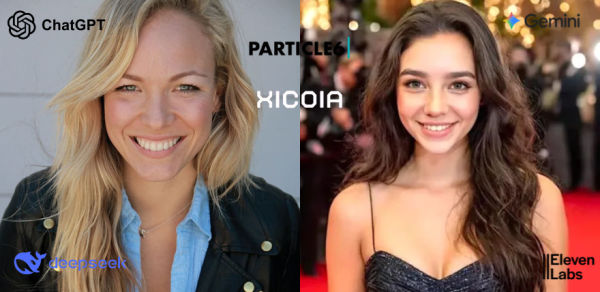
Generative AI shocked Hollywood in 2025 with the creation of the first AI actress, Tilly Norwood. Ms. Eline Van der Velden, former actress and comedian, is the creator of Tilly Norwood, according to cbsnews.com. Ms. Van der Velden and her team used ten AI-generation technologies and programs, including DeepSeek, ChatGPT, ElevenLabs, and Gemini, in order to create Tilly. In order to design Tilly’s face, experts used data from AI systems to create the ideal image of a movie star, according to nypost.com. According to Ms. Van der Velden, Tilly’s purpose is not to replace humans, but to act only with other AI actors, according to cbsnews.com. Tilly soon joined social media, and many prominent celebrities, including Mrs. Emily Blunt, Mr. Ryan Reynolds, Ms. Whoopi Goldberg, responded negatively to Tilly’s presence in the film industry. Xicoia, the AI talent agency founded by Ms. Van der Velden, plans to create at least 40 more AI actors in upcoming months. In partnership with Particle 6, also founded by Ms. Van der Velden, the company plans to work with human actors to create AI versions of themselves so they can work on multiple projects at a time, according to nypost.com. Mr. Pisani reflected on how AI developments can interfere with jobs in media.
“Like any new tool, there will be a disruption to the old way of doing things,” Mr. Pisani said. “With AI, it appears this disruption will be on a much wider scale. For workers in the media production industry, AI will replace some or much of what they have traditionally done; from screenwriting, to scoring music, to editing in post-production. In addition, film productions will need to decide if they will create their image on set, or use AI tools to create similar images at a fraction of the cost and with far fewer people involved. I believe large budget productions with large casts and crews will always be a big part of filmmaking, but AI will be a standard tool, at all levels of production from low budget independent films to major Hollywood big budget blockbusters.”
The most prominent impact of generative AI on filmmaking and TV is its ability to reduce expenses. With the help of generative AI, it is possible that TV and film companies may be able to reduce production expenses by 30 percent. This decrease in costs allows for companies to reallocate their savings towards their own growth, according to morganstanley.com.
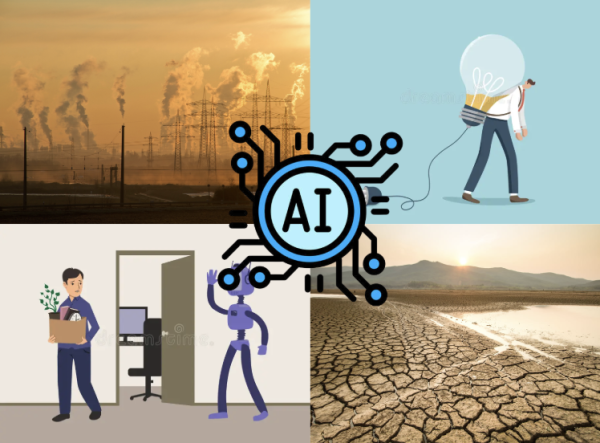
Although AI in the entertainment industry has potential benefits if companies utilize it responsibly, they cannot ignore its risks. These risks include include job displacement, lack of creativity, ethical and privacy concerns regarding data privacy, and deepfake technology, according to raindance.org. Additionally, the overuse of AI can negatively harm the environment, as AI emits mass amounts of carbon dioxide due to the significant amount of electricity it requires to function. It also leads to the depletion of water sources as cool water frequently regulates the temperature of data centers. For instance, when a user submits just one question to ChatGPT, it uses five times more electricity than a single web search, according to news.mit.edu. Mr. Pisani shared his thoughts on the future of AI within the media industry.
“No one knows for sure the extent to which AI will change filmmaking, especially as AI tools continue to improve and develop,” Mr. Pisani said. “With regard to independent filmmakers who traditionally have limited access to financing, A-list talent, and exotic locations, AI will help them express ideas and tell stories they would not have been able to even a couple of years ago. With respect to the filmmaking industry, there will be tremendous change in the way media is produced from using AI in the screenwriting process, to creating videos virtually, and to having AI execute substantial parts of the edit.”
Featured Image by Ruby Boeding ’28